Kerim's Triptych ❧ War on Gender, Sex in Sports, Woman with a Camel

Welcome 👋 to Kerim's Triptych, a free newsletter that delivers three fabulous links to your inbox, two or three times a month. (If you didn't intend to subscribe, or you don't want to receive these anymore, there is an unsubscribe link at the bottom.)
1️⃣ The War on Gender
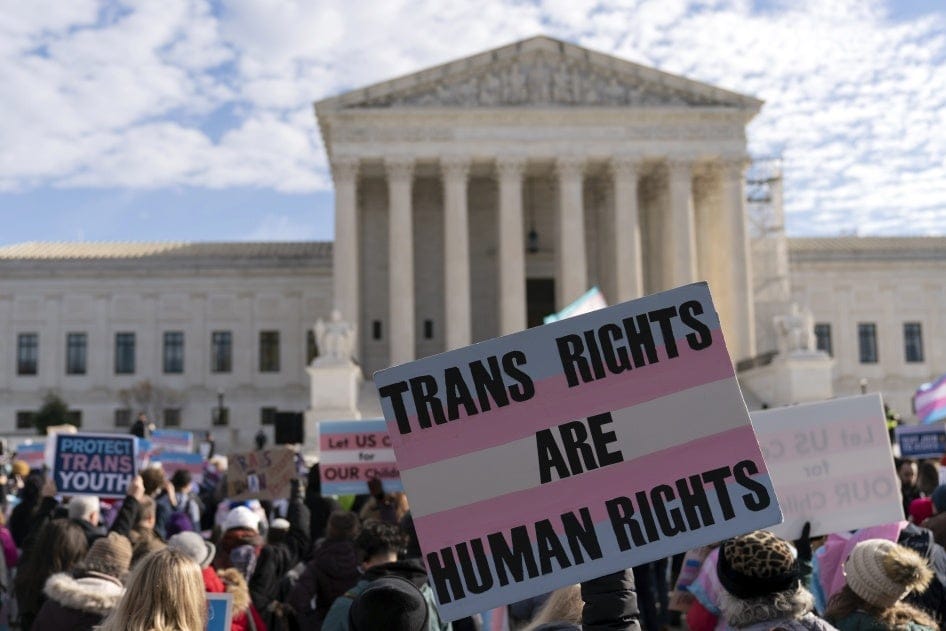
In the last issue of the newsletter I talked about the death of Kanzi the bonobo, who had amazed the world with his ability to communicate using a special keyboard. In that piece, I talked about how research on animal communication has slowly been overcoming the skepticism that researchers were attributing too much intentionality to their animal subjects. The same problem can be said of our current political moment. I'm always hesitant to attribute too much intentionality to Trump, when he seems to simply watch Fox News and then react. And yet . . . there does seem to be some method in his madness. If we look at the cumulative consequences of his actions they all somehow work to undermine government, while simultaneously increasing his own personal power. So it should not be a surprise that this is also true of his attacks on trans rights.
Paisley Currah makes this case in The New Yorker, arguing that "The push to eradicate so-called 'woke gender ideology' is also part of the assault on the government itself." Central to his thesis is an insightful analysis as to how government definitions of sex actually work:
Sometimes agencies’ decisions help trans people; sometimes they don’t. But there is usually an underlying rationale that calibrates a particular definition of sex to an agency’s purpose. In other words, when it comes to governing, sex is not an input, with a predefined meaning, determining the state’s rules. It’s an output, a creation of those rules, reverse-engineered to fit what an agency needs sex to do.
By denying agencies and local governments this flexibility to define sex as is needed for their own purposes, Trump's rules undermine their ability to do any work at all. For instance, Congress mandated scientific research has come to a screeching halt.
Jason Flatt, a researcher at the University of Nevada, Las Vegas, lost funding for a study that would have analyzed the medical records of two hundred thousand people in the course of ten years to understand more about dementia. “Of those two hundred thousand, only four thousand were L.G.B.T., but that was enough to have the award cancelled,” he said. “Basically, they’re saying all my grants are cancelled because they also include trans people.”
If we just look at the effects of these policies, then "the goal appears to be not just making villains out of gender and sexual minorities but, by dismantling the health, safety, and welfare infrastructure of the administrative apparatus."
2️⃣ Sex in Sports
Agustín Fuentes, author of the new book Sex Is a Spectrum: The Biological Limits of the Binary, has a nice short piece in the blog of the American Anthropological Association on the topic of sex in sports. He makes two simple points:
First, the contention that anyone assigned male at birth is always going to be better at sports than anyone assigned female at birth is simply not true. Second, for most people in most situations, a slight difference in athletic capacity rarely matters.
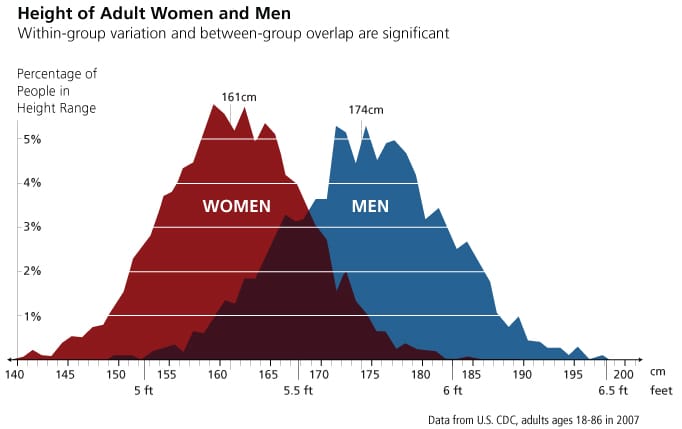
The first point is based on the fact that differences within human groups are always going to be bigger than differences between those groups. It is a point I spend a lot of time on in my classes, but I'm never quite sure it "sticks" with students. I use almost the exact same language Fuentes does here:
If you drew a random set of 50 individuals (25 males and 25 females) and lined them up by height the result would not be all males on one side and all females on the other. Rather, there’d (usually) be a majority of males in the taller half and a majority of females in the shorter half. But across the entire line up, the individuals would be mixed. To say that males are, on average, larger than females does not mean that every male is larger than every female. It simply projects that the averages in size between females and males, as categories, are separated by that percentage.
The second point is that, to the extent that there are biological differences accounted for by sex, these are really only statistically meaningful at elite levels, and at those levels almost none of us would qualify anyway.
Clearly, certain body size/shapes and strength patterns are specific prerequisites in some sports, especially at elite levels. But at those levels, the vast majority of people, regardless of sex or gender classification, could not make the cut. For most people, exactly where they fall in the wide range of variation in bodies and training (top half, lower half, middle, extreme ends, etc.) may be more relevant than their classified sex or gender in potential performance in any given sport. In fact, for children, most gendered divisions in sports do not come from biological necessity, they are cultural decisions, usually based on assumptions about limitations in girls’ abilities. And in some cases, the same is true for adults.
Despite being a relatively short blog post, there is a lot more there which I left out, such as the fact that women often benefit more from strength training then men. (Partially, because of cultural norms that affect their relative starting positions.) I've long used Fuentes's book, Race, Monogamy and Other Lies They Told You: Busting myths about human behavior, in my classes. I will probably end up using his sex book as well.
3️⃣ Woman with a Camel
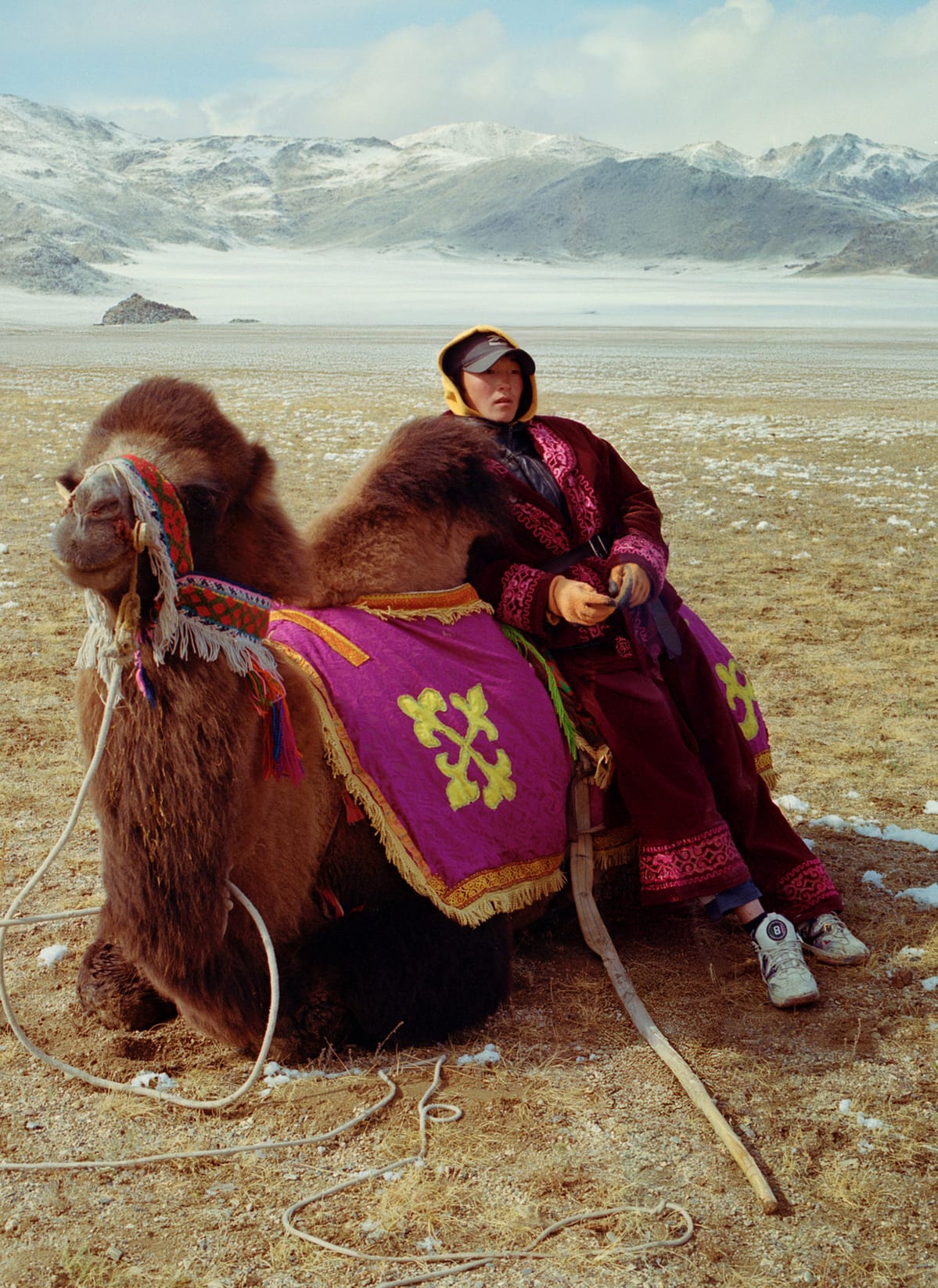
I absolutely love this picture of a woman leaning on a camel, taken from Megan K Eagles's documentary series "on the daily lives of Kazakh nomadic families who still practice the centuries-old art of eagle hunting." The location (it is shot in the Altai Mountains), the woman's nonchalance, the camel's bemused expression, but, most of all, the colors. I just love everything about it.
Endnote
❤️ Enjoying Triptych? Let your friends know! Encourage them to sign up via the Triptych website. I can't begin tell you how happy it makes me to see even one new subscriber!
💬 Or maybe you'd consider writing a short endorsement for the "kudos" page? You can just email it to me, or fill out this Google form.
💰 Want to ensure the long term sustainability of this newsletter? Consider becoming a sponsor. Sponsorship helps pay for my hosting costs as well as the newspaper and journal subscriptions which, in turn, allow me to provide "gift links" to all subscribers. A big shout-out to my current paid subscribers, you help keep me motivated!
🧧 Don't want to enter into a long term commitment, but still want to support the newsletter? You can always leave a one-time tip if you like.
🦋 Three links not enough for you? Follow me on Bluesky for all the links that don't make it to the newsletter. The newsletter also has its own Bluesky account.
Thank you!
Member discussion