Kerim's Triptych for Sunday, December 8th, 2024
Welcome 👋 to Kerim's Triptych, a free newsletter that delivers three fabulous links to your inbox, two or three times a month. (If you didn't intend to subscribe, or you don't want to receive these anymore, there is an unsubscribe link at the bottom.)
1️⃣ The Conspiracist Cabinet
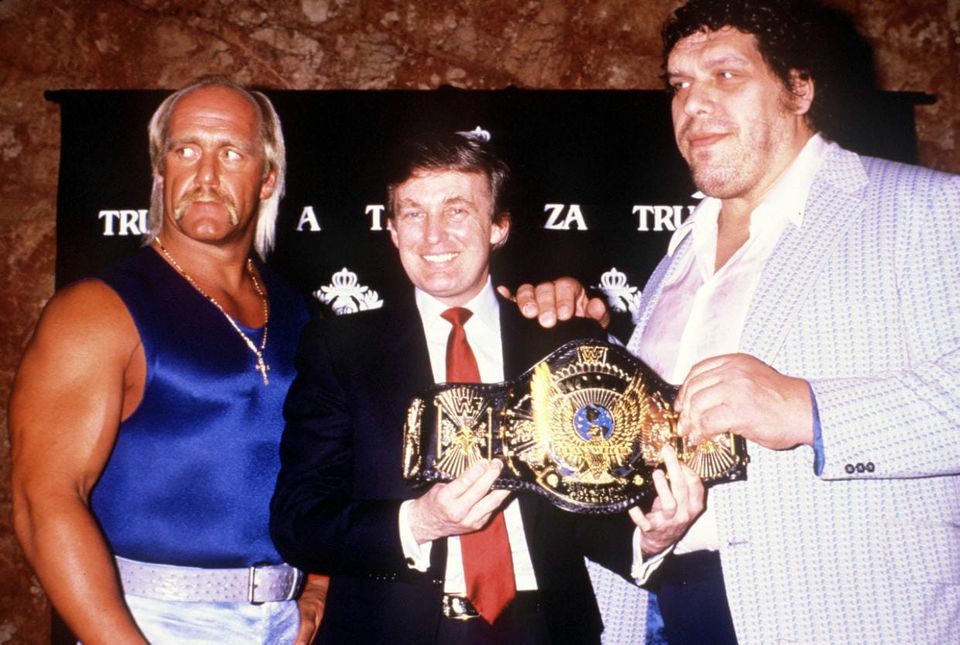
There are a number of ways to look at Trump's cabinet picks: as an assault on democracy, as a tactic to piss off liberals, as a depraved response to #metoo, etc. But one aspect that I think is especially worth exploring is the fact that so many of them are believers and spreaders of conspiracy theories. For this reason, I turned to the excellent Conspirituality Podcast to hear what they had to say about Trump's picks.
I recommend listening to the entire podcast, but the part that caught my attention asked the question: do conspiracy theorists really believe what they say and does it even matter if they do? (A topic I've discussed before in this newsletter.) In particular, I loved the discussion about professional wrestling, which I think can shed some light on our current moment.
The following is a cleaned up transcript of this section of the podcast which I made using AI —so it might not be 100% faithful to the original:
For a century, a significant portion of wrestling fans have known about kayfabe [that wrestling is staged]. Most believed the performers had to keep the role-playing under tight wraps. That was the rule: you’re never supposed to show that you’re faking . . . It’s called neo-kayfabe these days.
Wait—who calls it neo-kayfabe?
Scholars and people who study this recognize that now we’re in an era where fans know Vince McMahon has admitted it’s a lie, but they enjoy it anyway. Right. They’ve broken the rule that you’re not supposed to talk about it.
. . . when Trump lies, everybody knows it. Everybody knows that everybody knows it. But when liberals lie, they expect you to be fooled. And that’s so crucial. Wrestling ties into this. Vince McMahon, Linda, and Donald Trump have built their social capital on a kind of secret deal with the audience, letting them in on some hidden knowledge. It’s like Trump’s “I love the poorly educated” line.
Right. Trump tells his followers that all the business stuff—taxes, budgets—it’s all a scam. Look how I live my life, pulling fast ones. He’s winking and saying that’s his working-class appeal. He’s telling them the system isn’t real and that you are the sum total of your performances. Maybe you can be like him. It works because it strikes back against the condescension and liberal smugness the Red Scare women mentioned.
When liberals lie, Democrats expect us to believe it. Trump runs The Apprentice—everyone knows it’s fake. McMahon runs WWE—everyone knows it’s scripted. They create stories out of the cruelty of capitalism. It’s an alternate universe outside the boredom and hypocrisy of the state.
. . . I’m afraid that if we call them stupid, we play into their resentment. It makes us sound like Hillary Clinton calling them a basket of deplorables. They no longer believe in the lie of liberal economics. They have too many reasons to distrust it . . . No, they’re not Marxists. They sniff out the distrust. They see that this guy isn’t pretending to be anything other than an asshole.
They’ve bought into the idea that nihilistic chaos is all we have left. So now we have a pro wrestling president making pro wrestling nominations—people acting like they’re in important roles while everyone knows it’s bullshit.
2️⃣ Ground Game

One of the most astute thinkers about what needs to be done to save democracy is Astra Taylor. In this piece for The Guardian she talks about why it isn't enough to just spend millions on knocking on doors or getting people to vote. What we need is to build a grassroots social movement that is independent of the party and continues to build solidarity even on years when there is no presidential campaign.
Belittling and discounting Trump’s operation might make liberals feel better, but strategically, it’s self-defeating. This hubris leaves Democrats oblivious to their opponents’ achievements, while they overestimate their own approach. And it makes it harder to appreciate what needs to change if Democrats want to not only win elections but govern effectively and in ways that materially improve people’s lives.
. . . Our definition of “ground game” must evolve as well – “knocking on doors eight or nine times”, which is how O’Brien described his party’s efforts, will not be enough to remedy the Democrats’ current disadvantage or revitalize small-d democracy.
. . . When Democrats insist that Trump had no ground game, they ignore the right wing’s investment and presence in spaces that are not purely electoral and that engage people year-round . . . Ironically, the right not only has its own (often lavishly funded) political and cultural infrastructure; it also benefits from infrastructure’s absence in a way the left does not. Widespread feelings of isolation, loneliness and alienation help their cause.
. . . Democrats had plenty of money this year, much of which was contributed by smaller donors. But they spent it on the standard playbook. The Harris campaign spent billions blanketing the airwaves with ads . . . None of those tactics leave a trace after the campaign pulls up stakes. They might as well have set the cash on fire.
. . . better messaging must be coupled with a disciplined strategy to expand the voting base and win resounding majorities so politicians can actually deliver on a platform that makes this country more inclusive, sustainable, and fair.
3️⃣ Eolithism

Evgeny Morozov has long been one of the independent thinkers writing about tech. It was his early work that first challenged my techno-utopianism regarding social media. Certainly history has proved him right on that one. So when I saw that he had written something about AI in Boston Review, I immediately wanted to read it. I wasn't disappointed, but isn't what you might expect. It is less about the current state of AI than it is about the history of AI and what it might look like if it that history had looked very different.
What would AI look like if it hadn't been based on goal-driven problem-solving, but instead on what he calls "eolithism": "The contrast with the design mode of instrumental reason could not be more pronounced. Eolithism posits no predefined problems to solve, no fixed goals to pursue." It is more like play, or crafting for its own sake.
What sets Storm apart from other thinkers who have explored similar intellectual territory—like Claude Lévi-Strauss with his notion of “bricolage” and Jean Piaget with his observations of children and their toys—is his refusal to treat the eolithic mindset as archaic or merely a phase for primitive societies or toddlers. This longing for the heterogeneous over the rigid is not something people or societies are expected to outgrow as they develop. Instead, it’s a fundamental part of human experience that endures even in modernity. In fact, this striving might inform the very spirit—playful, idiosyncratic, vernacular, beyond the rigid plans and one-size-fits-all solutions—that some associate with postmodernity.
This being the Boston Review, half the pleasure of reading this piece lies in the discussion that goes along with it. In this case there are responses from Brian Eno, Audrey Tang, Terry Winograd, Bruce Schneier & Nathan Sanders, Sarah Myers West & Amba Kak, Wendy Liu, Edward Ongweso Jr., and Brian Merchant. All of them are worth reading, as well as Morozov's final reply.
Endnote
❤️ Enjoying Triptych? Let your friends know! Encourage them to sign up via the Triptych website. I can't begin tell you how happy it makes me to see even one new subscriber . . .
💬 Or maybe you'd consider writing a short endorsement for the "kudos" page? You can just email it to me, or fill out this Google form.
💰 Want to ensure the long term sustainability of this newsletter? Consider becoming a sponsor. A big shout-out to my current paid subscribers. Their contributions keep this place running — and help keep me motivated.
🧧 Don't want to enter into a long term commitment, but still want to support the newsletter? You can always leave a one-time tip if you like.
🦋 Three links not enough for you? Follow me on Bluesky for all the links that don't make it to the newsletter. The newsletter also has its own Bluesky account.
Thank you!
Member discussion